
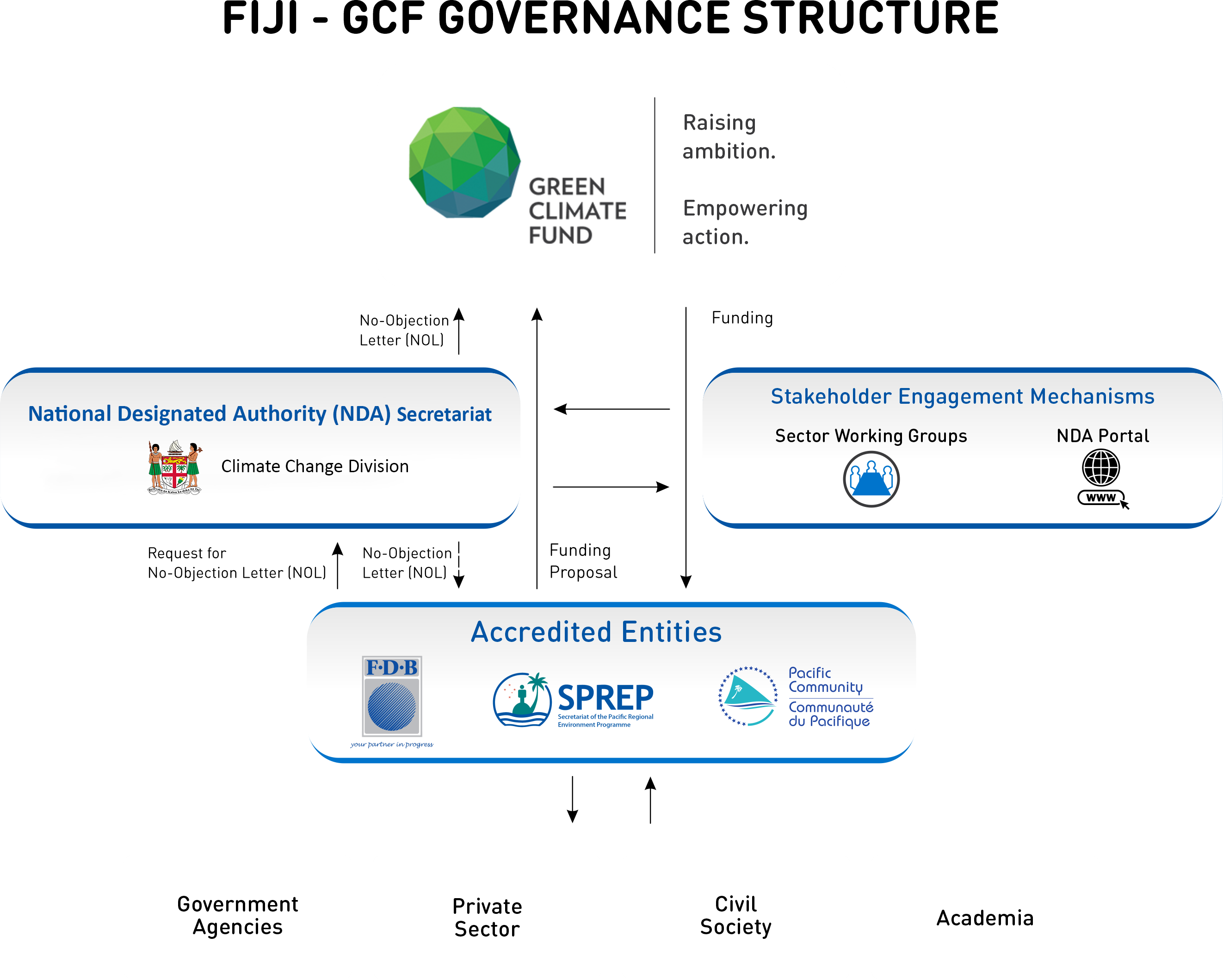
The Department of Climate Change of the Ministry of Environment and Climate Change acts as the National Designated Authority (NDA) for Green Climate Fund. The NDA is the fundamental intermediary and point of communication between stakeholders in Fiji and the Green Climate Fund (GCF). The NDA is the Honorable Minister of Environment and Climate Change with the Permanent Secretary and the Director of the Department Climate Change as her representative. Furthermore, NDA is the authority that the GCF recognizes for all legal matters pertaining to the GCF and is the official signatory on behalf of the Fijian government. The NDA provides broad strategic oversight of the GCF activities in the country.
As a Small Island Developing State on the frontlines of climate change, Fiji uses the GCF as a key vehicle to finance priority mitigation and adaptation actions identified in national policies, including the Climate Change Act, National Climate Change Policy, National Adaptation Plan and Fiji’s Nationally Determined Contribution (NDC).
NDA Secretariat
The Ministry of Environment and Climate Change (MECC), through the Department of Climate Change, serves as Fiji’s National Designated Authority (NDA) to the Green Climate Fund. The NDA is responsible for:
- Providing national oversight and coordination of GCF engagement.
- Ensuring that all GCF proposals are aligned with Fiji’s climate and development priorities;
- Issuing “No-Objection” / Letters of No Objection (NOLs) for GCF funding proposals;
- Engaging with Accredited Entities, line ministries, private sector, CSOs and communities to build a strong country-driven GCF pipeline;
- Mobilizing readiness support and technical assistance to strengthen national institutions and systems for climate finance.
Green Climate Fund (GCF)
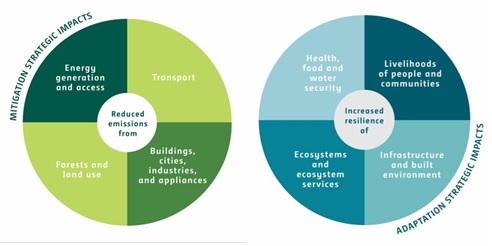
The eight strategic results areas of GCF (Source: GCF, 2018)
GCF is a global climate finance fund created to support the efforts of developing countries to respond to the challenge of climate change. GCF was set up in 2010 by the 194 countries who are parties to the United Nations Framework Convention on Climate Change (UNFCCC), as part of the Convention’s financial mechanism.
The Fund seeks to promote a paradigm shift to low‐emission and climate‐resilient development, considering the needs of nations particularly vulnerable to climate change impacts.
GCF activities are aligned with the priorities of developing countries through the principle of country ownership. The disbursement of funds by the GCF must be consistent with the national objectives of the countries where projects and programs will be taking place.
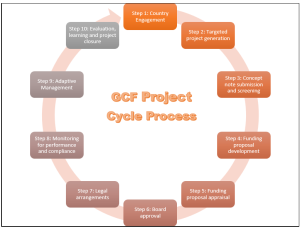
How Fiji accesses GCF funding
Fiji accesses GCF resources through Accredited Entities (AEs), which can be:
- Direct access / national entities, such as the Fiji Development Bank (FDB); and
- Regional and international entities, such as multilateral development banks and UN agencies.
Project ideas are developed in collaboration with the NDA and Accredited Entities and then submitted to the GCF Board for approval. To ensure country ownership and alignment with national priorities, all GCF concepts and proposals for Fiji require a No-Objection Letter from MECC as the NDA before they can be submitted to the GCF Secretariat.
Executing Entities (EE)
Executing Entities (EEs) are institutions responsible for the execution of projects or programmes funded by the GCF. They can be entities from the public, private and CSO sectors. Essentially, AEs can be EEs as well.
EEs do not get direct access to the GCF, in contrast to accredited entities. EEs ensure that GCF projects are delivered in accordance with project objectives.
EEs must demonstrate specific criteria and qualifications, for example:
- Proven track record in implementation and monitoring of climate project/programme;
- Transparent system for data management and record keeping and archiving;
- Appetite for implementation and ensuring ownership and demand driven concepts and project ideas and its formulation;
- Absorptive capacity to implement and Monitoring, Reporting and Verifying (MRV) of project/programme and to scale up and replicate the solutions beyond the one-off project;
- Strong business acumen and entrepreneurial spirit; and
- EEs will need to be trained and fully capacitated in the skills and knowledge to access and utilize climate finance.
Accredited Entities (AE)
Accredited Entities are institutions that can access funding from the GCF, after an accreditation process. There are different types of the GCF Accredited Entities, based on access modalities:
- Direct Access Entities: Fiji Development Bank (FDB)
- Regional Accredited Entities
- International Accredited Entities
Organizations with specialized climate action capacities can apply to become the GCF Accredited Entities. They can be private, public, non-governmental, sub-national, national, regional, or international bodies. They should have clear, detailed, and actionable climate change projects or programmes to present to the GCF. They must also meet the GCF standards such as financial standards, environmental and social safeguards, and gender equality and social inclusion (GESI). Accredited Entities develop funding proposals for consideration by the GCF. They also oversee, supervise, manage, and monitor their respective GCF-approved projects and programmes.
Direct Access Entities (DAE)
The Fiji Development Bank (FDB) is accredited for micro size projects which are capped at USD 10 million. These projects could be used as loan, equity, or guarantee.
The FDB is a national public sector entity and Government-owned development bank based in Fiji. The main objectives are facilitating and stimulating the promotion and development of natural resources, transportation, other industries, and enterprises in Fiji. Special consideration and priorities include the economic development of the rural and agricultural sectors of the economy.
Direct Access Entities (DAE) are sometimes also called National Accredited Entities.
Regional Accredited Entities (RAE)
The Secretariat of the Pacific Regional Environment Programme (SPREP) is a Regional AE to the GCF since May 2015. SPREP intends to apply GCF resources as grants. It targets adaptation and mitigation projects focusing on Small Island Developing States (SIDS) and building national capacity to address climate change. To date, SPREP has one GCF approved project: FP035: Climate Information Services for resilient development in Vanuatu (USD 26.6 million).
SPREP is based in Apia, Samoa. It focuses on climate change and environmental issues affecting SIDS in the Pacific. SPREP supports action on climate change in the key areas of adaptation, mitigation, policy and science. SPREP intends to build upon its current experience. Future focus includes integrated approaches to addressing climate change, disaster risks, and ecosystem-based adaptation projects and programmes in SIDS.
The Pacific Community (SPC) is accredited under the small project scale (<USD 50 million) and Cat B (Medium Risk Category) since February 2019. SPC currently has one GCF approved project: FP169: Climate change adaptation solutions for Local Authorities in the Federated States of Micronesia (USD 19.7 million).
The SPC headquarter is based in Noumea, New Caledonia. It is the regional principal scientific and technical organization supporting development in the Pacific region. SPC focuses on sustainable economic development, empowered and resilient Pacific communities and enhanced health and livelihoods of Pacific people with a view to achieving its members’ development goals.
International Accredited Entities (IAE)
Different United Nations agencies with offices in the Pacific are IAEs. This includes the:
- United Nations Development Programme (UNDP)
- Food and Agriculture Organization (FAO)
- United Nations Environment Programme (UNEP)
Multilateral development banks and other entities include the:
International Non-Government Organizations (NGOs) include the:
Fiji’s GCF portfolio
Fiji has an expanding portfolio of GCF-supported activities, including national projects, participation in multi-country programmes and several readiness initiatives.
Approved national projects
Fiji Urban Water Supply and Wastewater Management Project (FP008) – implemented with the Asian Development Bank, this project improves water supply security and wastewater services in Greater Suva, enhancing resilience to climate-induced droughts and flooding.
https://www.greenclimate.fund/project/fp008
Multi-country projects including Fiji
Adapting tuna-dependent Pacific Island communities and economies to climate change (FP259) – supports climate-resilient management of tuna resources and economies across Pacific Island countries.
https://www.greenclimate.fund/project/fp259
Multi-country Project Advancing Early Warnings for All (EW4All) (FP258) – strengthens multi-hazard early warning systems and climate information services in participating countries, including Fiji.
https://www.greenclimate.fund/project/fp258
Global Fund for Coral Reefs Investment Window (FP180) – mobilises climate and ocean finance for coral-reef-dependent communities, with Fiji among the participating countries.